How AI video intelligence is turning passive surveillance into a live, searchable network
— and what that means for investigation, safety, and the future of security?
For years, surveillance worked like this: Something happened. Then we went looking for it. Rewind the footage. Scrub the timeline. Zoom into a grainy frame. Hope the camera angle was kind enough to show you something useful.
That model has one fundamental flaw — it assumes investigation begins after the event.
AI is changing that assumption entirely.
—
From Footage to Searchable Intelligence.
The first wave of AI video intelligence was already a leap forward:
Upload CCTV footage → type what you’re looking for → get timestamps, clips, and extracted frames in seconds.
That alone cut investigation timelines from days to minutes.
But the second wave is bigger. Much bigger.
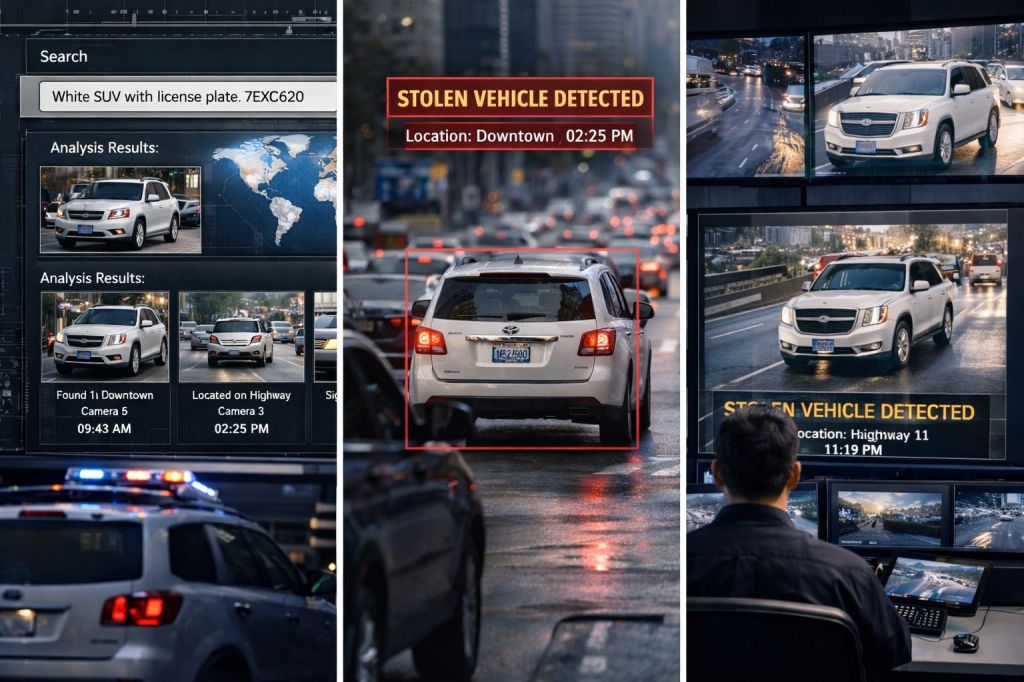
Imagine a secure portal where you:
– Type a description: “Black SUV, partial plate AB12”
– Upload a photo of a missing person or suspect
– Enter a behavioural cue: “Group of 5 gathering aggressively near gate 3”
– Set your location and time window
And instead of searching one camera feed — the system queries an integrated live CCTV network across zones, districts, and cities.
It returns:
– Where the subject was last detected
– Which camera ID picked it up
– Exact timestamp
– Full movement trail
– Confidence score
– Real-time sighting updates as they happen
This isn’t forensic review anymore. This is live AI surveillance intelligence.
And it’s not theoretical — agencies globally are already integrating camera networks with AI indexing layers.
—
Why Network Integration Changes Everything
Standalone AI is useful. Integrated AI is transformative.
When cameras work in isolation, intelligence stays local. When they work as a network, intelligence becomes spatial.
A vehicle isn’t just *seen* — it’s tracked across:
Traffic cameras
Retail parking lots
Highway toll systems
Smart city intersections
Public infrastructure feeds
The question stops being:
> “Did this camera capture it?”*
And becomes:
> *”Where in the network did it appear?”
That’s a fundamentally different kind of power.
—
The Tech Behind It (Without the Jargon)
Making this work at scale requires a lot more than object detection. The infrastructure underneath includes:
Cross-camera Re-Identification (ReID) — recognizing the same person or vehicle across different cameras, angles, and lighting conditions.
Federated Camera Indexing — connecting thousands of distributed feeds into one queryable layer without centralizing the raw footage.
Real-Time Stream Ingestion — processing live video as it happens, not after the fact.
Prompt-Based Semantic Search — letting investigators type natural language queries instead of writing code or manually tagging clips.
Encrypted Data Pipelines + Audit Logs — so every query is traceable and every access is accountable.
The system doesn’t just detect. It correlates. And correlation is where the real investigative power lives.
—
Real Use Cases That Change the Stakes
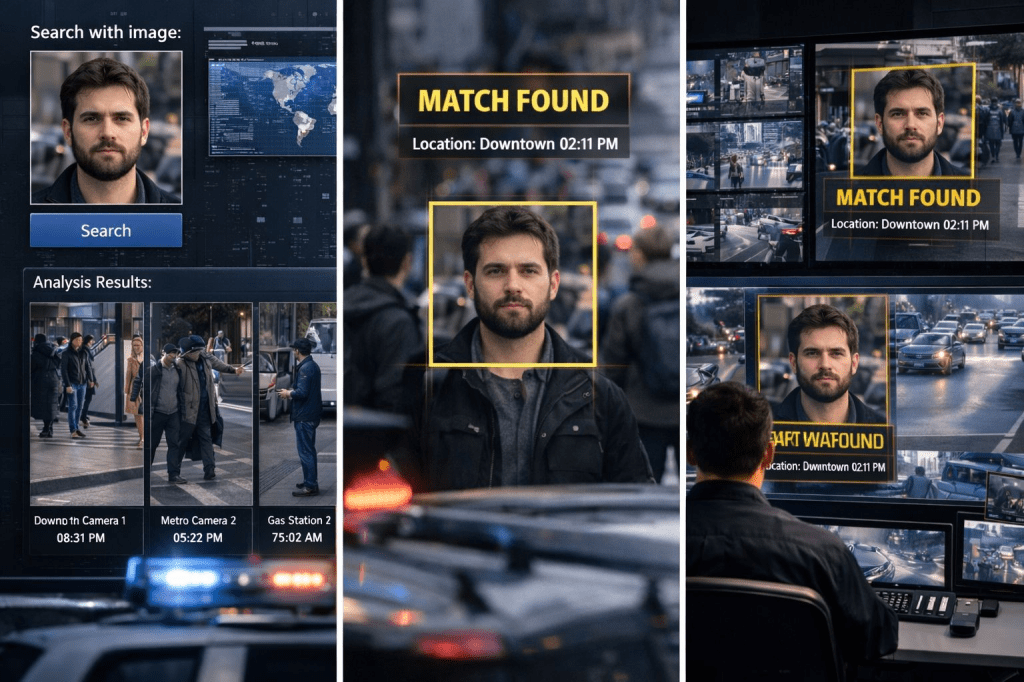
Missing Person Search
Instead of broadcasting an image and waiting for public tips:
1. Authorities upload a photo into the AI portal
2. The system scans integrated live feeds
3. It matches facial vectors or clothing signatures
4. Flags detections, maps movement across zones
5. Sends real-time updates as new sightings occur
Response time shrinks. Uncertainty reduces. Decisions accelerate.
—
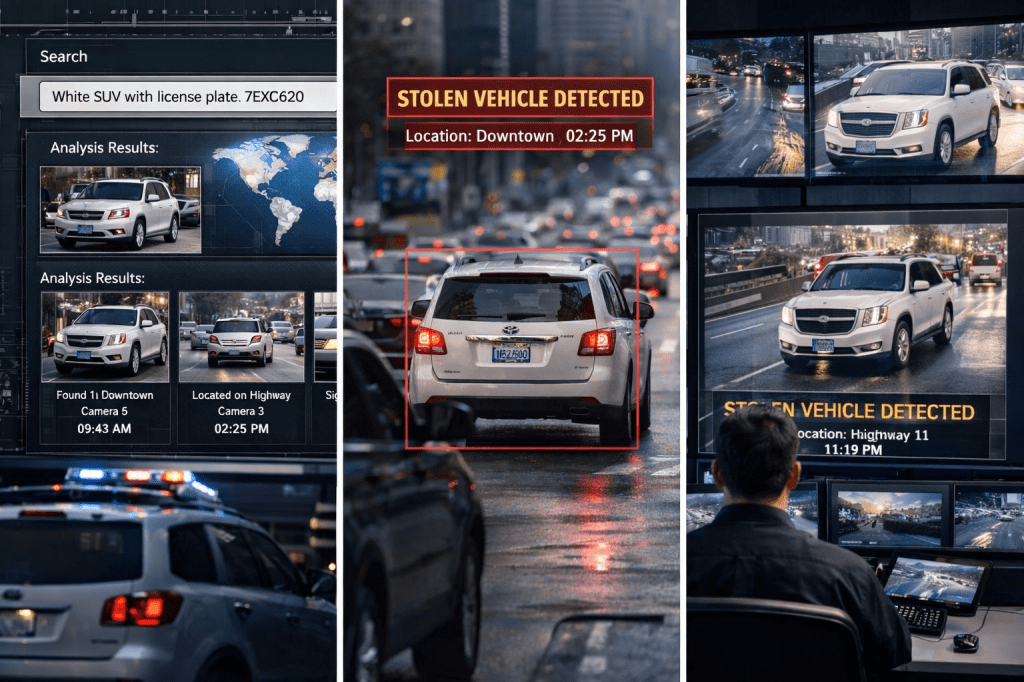
Stolen Vehicle Tracking
A license plate is reported stolen. Instead of manual traffic checks:
1. Plate entered into the system
2. AI monitors ANPR (Automatic Number Plate Recognition) feeds city-wide
3. Flags live detection the moment it appears
4. Tracks route pattern and predicts likely trajectory
Law enforcement moves from reactive to anticipatory.
—
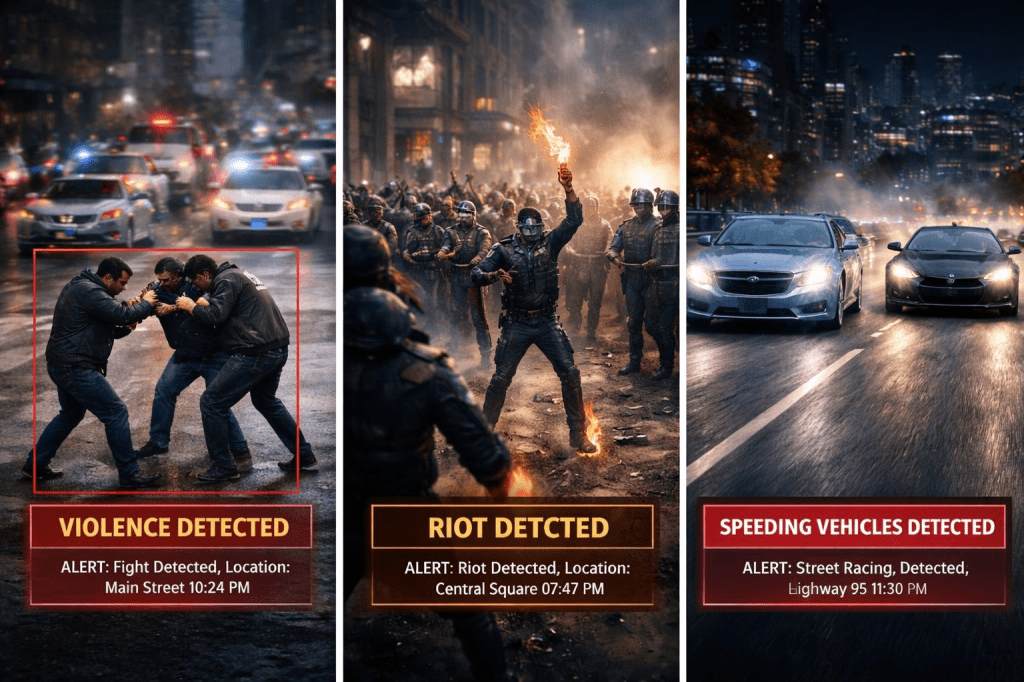
Crowd & Behaviour Monitoring
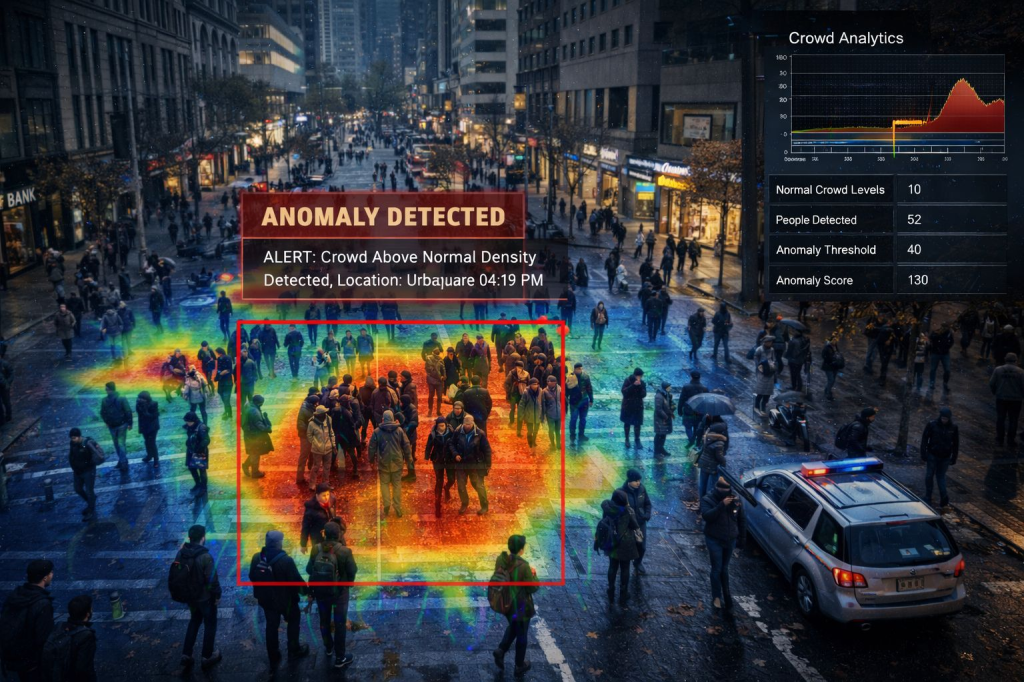
Integrated surveillance can also detect behavioral patterns before they escalate:
– Unusual crowd density spikes
– Rapid dispersal events
– Aggressive motion clustering
– Road rage escalation patterns
Instead of waiting for an incident report, systems flag anomaly thresholds in real time — changing how emergency response is deployed.
—
I Know What You’re Thinking
“Here we go again — another flashy AI concept with zero real-world depth.”
Stay with me. Because this isn’t hype. The infrastructure exists. Pilots are running. The question isn’t whether this technology will be deployed — it’s whether institutions will deploy it responsibly.
—
The Competitive Edge That’s Quietly Forming
Here’s what’s actually happening right now:
Early adopters of integrated AI surveillance are gaining structural advantage — not just operationally, but informationally.
Organizations integrating AI-powered video intelligence today are:
– Cutting investigation timelines dramatically
– Building predictive response capabilities
– Creating centralized forensic dashboards
– Strengthening data-driven governance
– Operating with information asymmetry over those who aren’t
The agencies integrating first will simply know more, faster. And in security and law enforcement, that gap compounds quickly.
—
The Ethical Question That Cannot Be Skipped
This is powerful infrastructure. And power demands governance.
The same system that can locate a missing child in 20 minutes can also become mass surveillance overreach if deployed without guardrails.
Any responsible deployment of integrated AI surveillance must include:
– Strict legal authorization frameworks
– Role-based access controls (not everyone can query everything)
– Transparent, tamper-proof audit logs
– Privacy-preserving architecture
– Clear scope limitations on what can be searched and by whom
– Data minimization — store only what’s needed, for only as long as needed
Governance isn’t optional here. It’s foundational.
The technology will exist regardless. The real question is whether institutions have the maturity to deploy it proportionately — and the accountability structures to prove it.
—
The Bigger Pattern
Think about what’s happened to every major unstructured data type:
– Text became searchable → Google
– Images became searchable → reverse image search, facial recognition
– Audio became searchable → voice search, transcription AI
– Video — including live video — is next.
When live video becomes fully queryable, the physical world becomes indexed. And when the world is indexed, the balance of response, prevention, and control shifts in ways we’re only beginning to understand.
—
Why I’m Building in This Space
First check the quick DEMO, for serious readers-
Because I believe the next infrastructure layer isn’t more hardware.
It’s intelligence on top of existing hardware.
Cameras already blanket cities. What’s missing is interpretation at scale — the ability to turn passive recording into active, queryable understanding.
When you can:
1. Upload an image
2. Type a prompt
3. Search across networks
4. Receive structured, actionable answers

 Y Prateek
Leave a comment