DayOneontheWater:ABeginner'sGuidetoSailing(andArguingWiththeWind)

I always assumed sailing was simple: put up a sail, catch the wind, go. My first day out on Toronto Harbour corrected that fast — thanks to Nick, who took me out on his dinghy, Mirror Water, and turned a curiosity into an actual afternoon on the water.
I'm writing this partly as a reference for myself — the stuff that finally clicked once I was holding the ropes instead of reading about it. If you're about to try sailing for the first time, I hope it saves you an afternoon of confusion (and maybe a capsize).
The one idea that changes everything: you can't sail into the wind
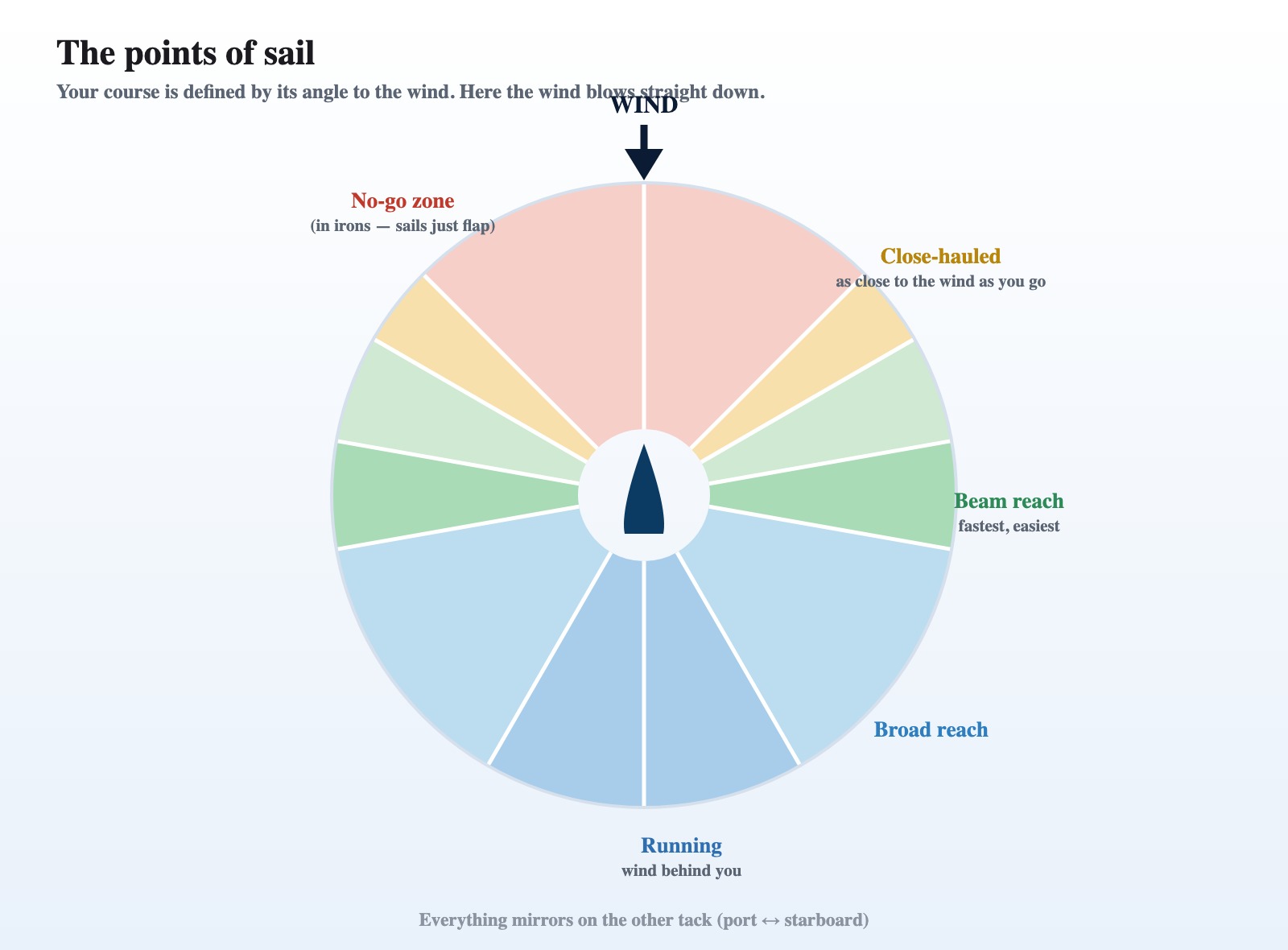
This is the fact that reorganizes your whole mental model. You cannot sail straight toward where the wind is coming from. There's a wedge — roughly 45 degrees either side of the wind, about 90 degrees total — where the sail just flaps and the boat stalls. Sailors call it the no-go zone.
So the direction you can sail depends entirely on your angle to the wind. These angles are the points of sail:
- Into the wind (in irons): pointed straight at the wind — the no-go zone. The sail flaps (luffs) and you stop. This is where you accidentally end up as a beginner.
- Close-hauled: as close to the wind as you can sail, about 45 degrees off it. Sails pulled in tight. This is how you make progress toward the wind — but only by zig-zagging (more on that below).
- Reaching: wind coming across the side of the boat. A beam reach (wind at 90°) is the fastest, easiest, most fun point of sail. Ease the sails out about halfway.
- Running: wind coming from behind you, pushing you along. Sails let all the way out. Feels calm, but it has its own traps (see jibing).
The trick I kept forgetting: the sail setting changes with your angle to the wind. Close to the wind, pull the sail in tight. Away from the wind, let it out. Get that wrong and you either stall or lose power.
Getting upwind: tacking (the zig-zag)
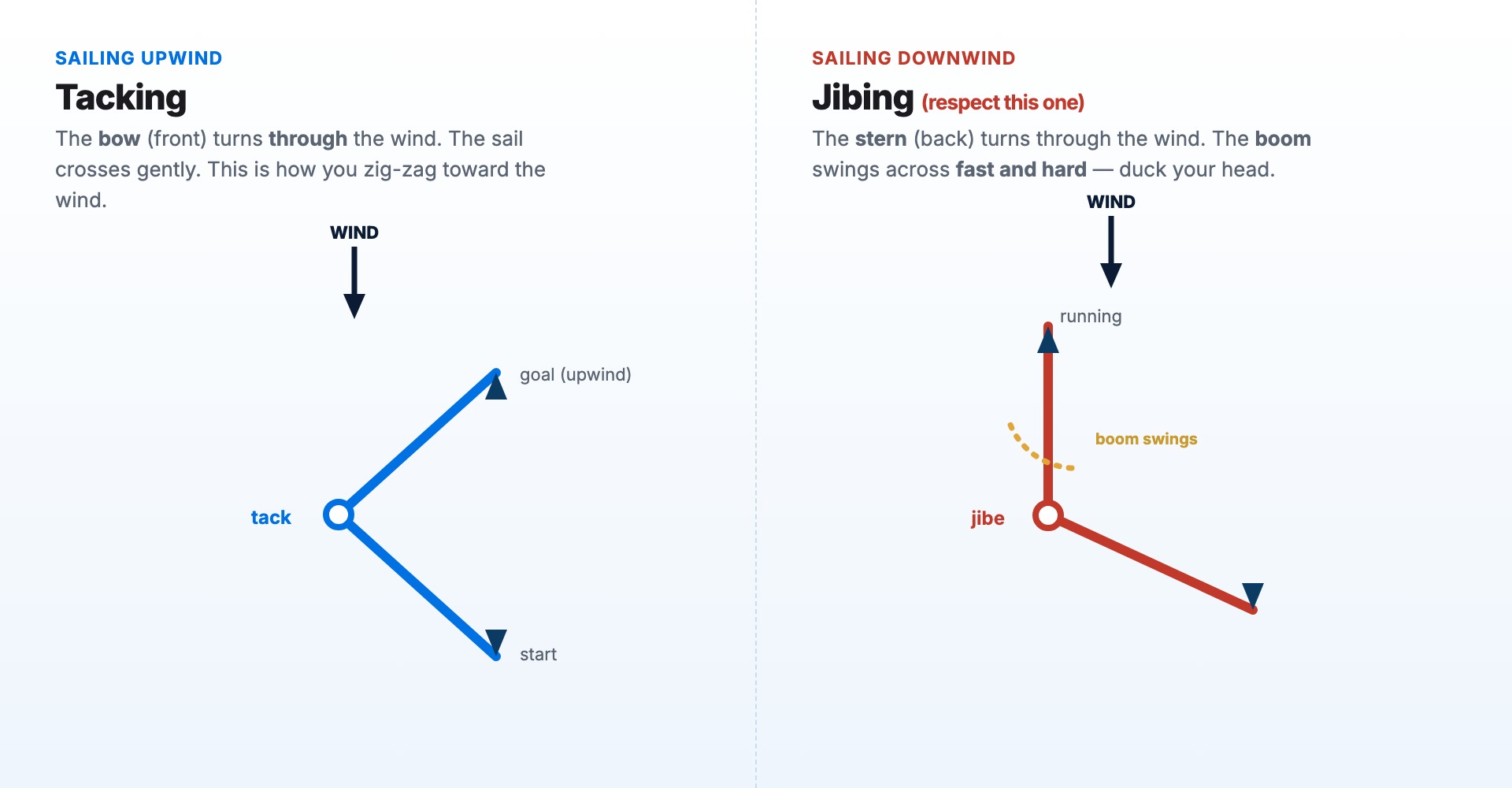
Because you can't sail straight at the wind, reaching an upwind destination means going at it diagonally, first on one side, then the other — a staircase. This is called beating, and each turn is a tack.
A tack is when you turn the bow (front) of the boat through the wind, so the wind crosses from one side of the boat to the other and the sail swings across. The sequence:
- Skipper calls "Ready about?" — crew replies "Ready!"
- Skipper calls "Helms-a-lee!" (or "Lee-ho") and pushes the tiller across.
- The bow swings through the wind, the sail flaps for a second, then fills on the new side.
- Everyone shifts to the new high side, and you settle onto the new course.
That "left, then right, then left again" is the whole game when you're headed upwind. It's most of what I did all afternoon before I knew the word for it.
Getting downwind: jibing (the one to respect)
The mirror-image maneuver is a jibe (also spelled gybe): turning the stern (back) through the wind while sailing downwind. The catch is that the boom — the horizontal pole at the bottom of the sail — swings across fast and hard during a jibe, because the wind is behind it. That swinging boom is the classic way beginners get knocked (so you duck, and you control it). Tacking is gentle; jibing demands attention.
The parts and the terms — a beginner's glossary
Here's every term that stopped being jargon once I was on the water:
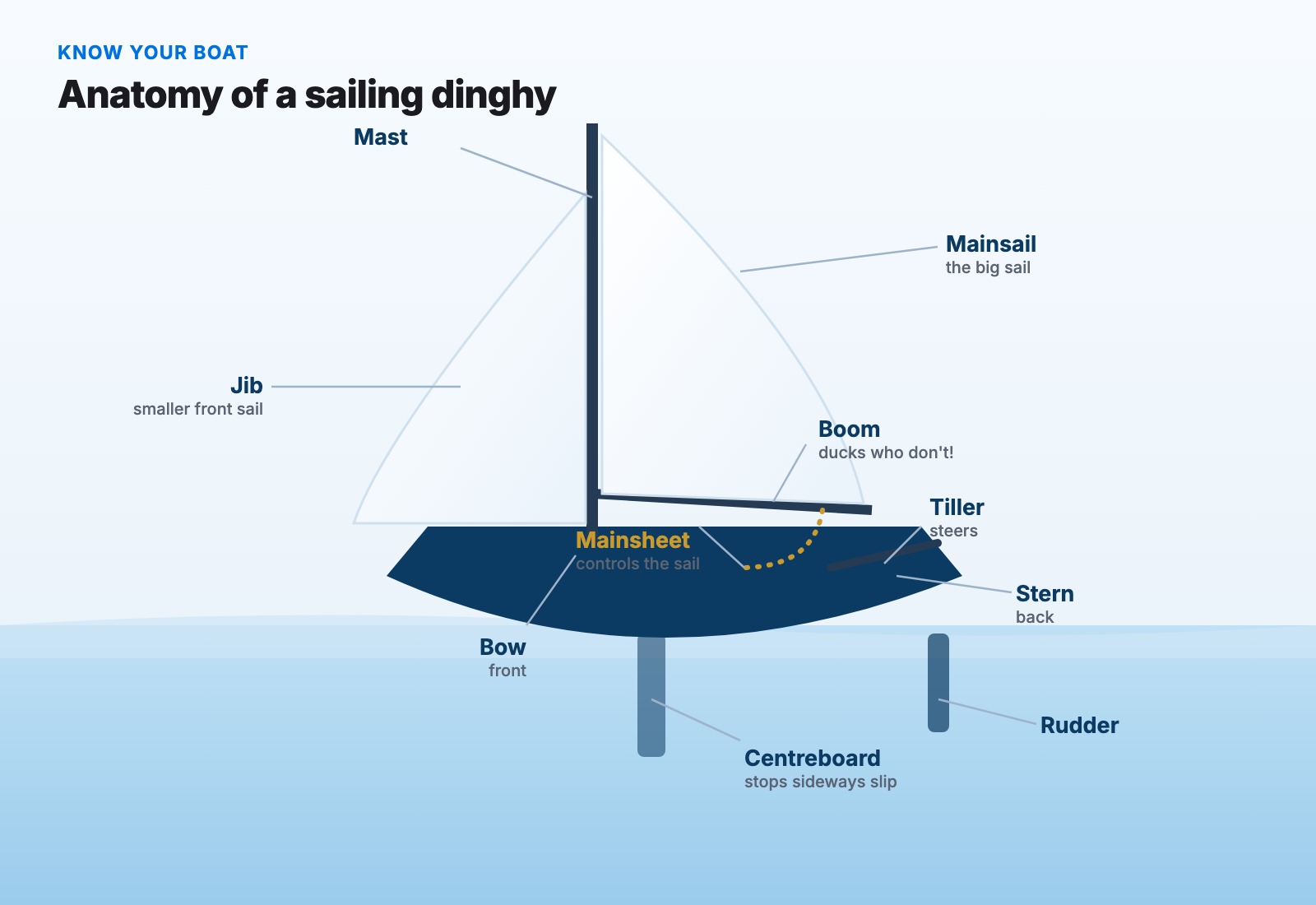
- Bow / stern — the front / back of the boat.
- Port / starboard — left / right, when you're facing the bow. (Trick: "port" and "left" both have four letters.)
- Windward / leeward — the side the wind hits / the sheltered side away from the wind. You sit on the windward side and lean out to balance the boat.
- The tiller — the stick that steers (it moves the rudder underwater). It feels backwards: push it left and the boat turns right. Push it toward the sail and you turn away from the wind. Trusting this took me a while.
- The mainsail — the big sail. The jib is the smaller sail in front.
- The boom — the horizontal pole along the bottom of the mainsail. Watch your head.
- The mast — the vertical pole the sails hang from.
- The mainsheet — the rope that controls the mainsail. Pull it in = trim; let it out = ease.
- Luffing — when the front edge of the sail flaps because you're too close to the wind or the sail's too loose. It's the boat telling you to adjust.
- Heeling — when the boat leans over. Normal up to a point; too much means you need to depower.
- Centreboard / daggerboard — the fin under a dinghy that stops it sliding sideways. Down when sailing upwind, up when running downwind.
- Telltales — little strands of yarn on the sail that show you if the wind is flowing smoothly. Beginner's best friend for trimming.
- In irons — stuck pointing into the wind with no steering. It happens; you back the sail or paddle out of it.
What three laps actually taught me
We did three laps of a short course. First lap, I was a passenger in my own boat, reacting late to everything. Second lap, with Nick calling the moves and talking me through each turn, the tacks got cleaner — "ready about," then over she goes. By the third, I could feel the boat before it did something, and I made a couple of turns that felt deliberate instead of lucky. Nick's patience did most of the heavy lifting there.
Here's a clip from the day out on the water:
When the boat heeled over hard the first time, the instinct was to panic. The fix turned out to be calm: ease the sail, shift your weight up to the high side, and it settles. Learning not to yank everything at once was half the lesson.
5 tips I'd give a first-timer
- Always know where the wind is coming from. Feel it on your face, watch the flags on shore, look for ripples and darker patches on the water. Every decision on the boat follows from this one piece of information.
- "When in doubt, let it out." If you're unsure how to set the sail, ease it until the front edge luffs, then pull in just until it stops flapping — that's correct trim. And easing the mainsheet is your instant brake: when it feels scary, let the sail out and the boat calms down.
- Keep your head out of the boat. Look ahead and at the water, not down at your hands. Sailing is anticipation — you want to see the gust or the turn coming, not react to it late.
- Mind the boom, and keep the boat flat. Duck during every tack and especially every jibe. Balance your weight so the boat stays roughly level — a flat boat is a fast, controllable boat.
- Start small and go with someone who knows. Light wind, a small dinghy, and an instructor or experienced friend beats reading ten guides. You learn this with your hands, not your head.
Why I'm hooked
Sailing isn't fighting the wind, and it isn't just being pushed by it. It's reading the wind and using its angle to go somewhere it isn't trying to send you. On a flat day in the harbour, with the city on one side and open water on the other, that clicked in a way a diagram never could.
Day one, and I'm already hooked. Back out next weekend — this time I'll know what "helms-a-lee" means before someone shouts it.
Thank you, Nick
None of this happens without Nick. Thank you for the invitation, for trusting a complete first-timer with a spot on Mirror Water, and for the calm, patient coaching that made a confusing thing suddenly make sense. Handing over your boat and your afternoon to someone who's never sailed takes real generosity — and it's the kind of gesture that turns a "someday" into a "did it."
A big thank-you to Nick's team too, who made me feel welcome from the moment I stepped on the dock. Great people make a great first day. Nick — this experience is because of you. Genuinely grateful, and I'll be back.